

From Credential Screening to Portfolio-Based Hiring: An Evidence-Based Analysis of Contemporary Recruitment Transformation
The Higher Education Lab | Credential Collapse Series: ‘The Employer Perspective —"Portfolio-Based Hiring vs Degree Requirements: How Top Companies Improved Retention and Performance (3/5)
The Hiring Manager's Dilemma: Why Degree Filters Screen Out the Talent You Need (2/5)
The Employer Perspective — Why companies stopped requiring degrees (1/5)
Abstract
This article examines the empirical shift from credential-based to portfolio-based hiring practices among leading multinational corporations. Drawing on organizational performance data and labor market research, we analyze how skills-first recruitment strategies impact retention rates, time-to-fill metrics, and cost-per-hire outcomes. The findings suggest that portfolio-based evaluation systems demonstrate superior predictive validity for job performance compared to traditional degree requirements, with implications for both employers and higher education institutions.
## Key Takeaways
- Degree requirements often function as weak proxy signals rather than strong predictors of job performance.
- Portfolio-based hiring and skills assessments demonstrate stronger predictive validity for retention and performance.
- Organizations implementing structured portfolio review report faster time-to-fill and improved candidate matching.
- Skills-based hiring expands talent pools while maintaining or improving quality outcomes.
- For students, demonstrable work and execution capability increasingly matter more than transcript metrics alone.
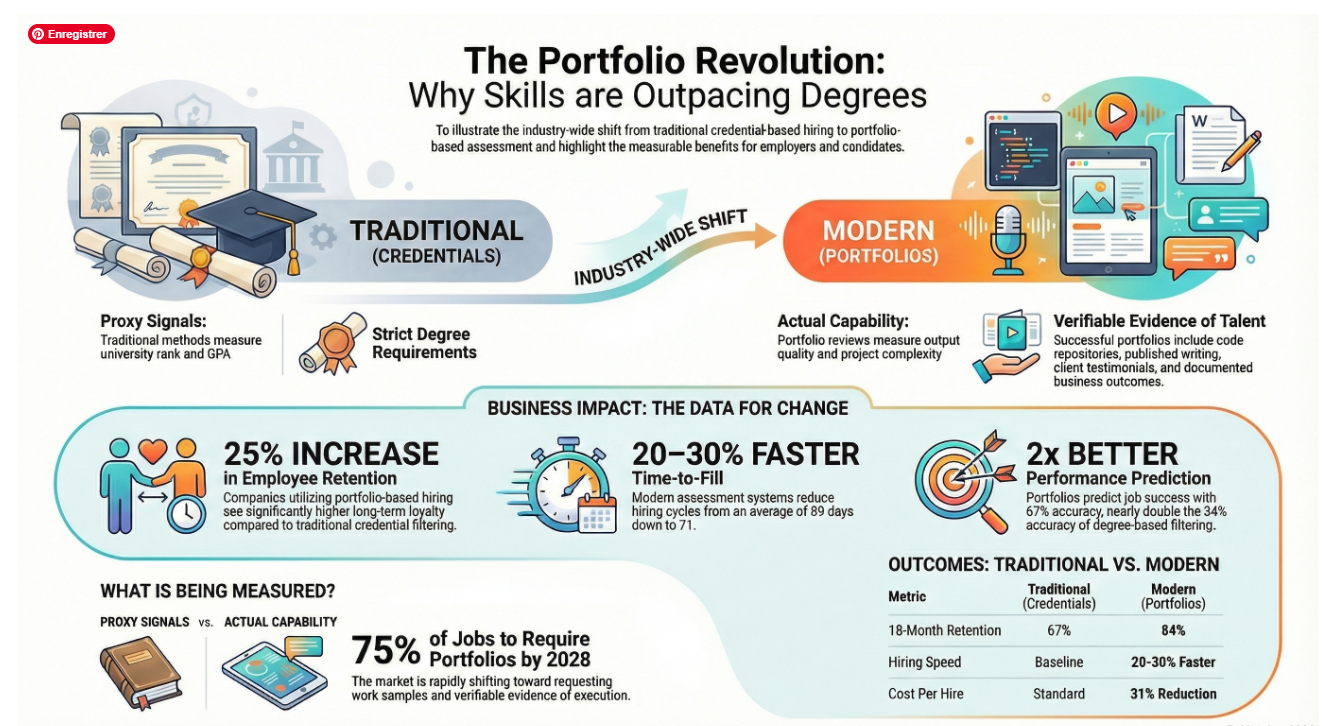
This infographic illustrates the shift from traditional credential-based hiring to portfolio-based assessment. It compares strict degree requirements and GPA filtering with modern portfolio review and skills assessments. The data highlights measurable business outcomes, including 25% higher employee retention, 20–30% faster time-to-fill, and 2x more accurate performance prediction when companies evaluate demonstrated work instead of academic credentials.
Introduction
Over the past half-decade, major employers, including IBM, Accenture, and EY have implemented fundamental changes to their talent acquisition models. This transformation reflects not ideological positioning but rather empirical evidence regarding hiring efficacy and organizational performance.
After conducting comprehensive internal performance analyses, numerous organizations identified that degree requirements systematically reduced available talent pools without demonstrably improving job performance, employee retention, or recruitment efficiency (Fuller et al., 2022). Consequently, these organizations replaced traditional credential screening methodologies with portfolio-based hiring and competency assessments.
The documented outcomes include:
Retention improvements of up to 25%
Reduction in time-to-fill metrics by 20–30%
Decreased cost-per-hire
Expansion and diversification of candidate pools
This analysis examines the empirical basis for corporate migration from credential filters to portfolio review systems and explores implications for students and educational institutions.
The Predictive Limitations of Degree-Based Filters
Traditional Credential Screening
For over a decade, many organizations employed standardized screening criteria:
Bachelor's degree requirement
Minimum grade point average thresholds
Institutional prestige preferences
These filters were designed to streamline candidate evaluation. However, longitudinal performance data revealed significant limitations in their predictive validity.
Empirical Evidence from Fortune 500 Organizations
Internal audits at major corporations documented the following comparative outcomes:
Credential-Based Hiring Model (2022)
Average time-to-fill: 89 days
18-month retention rate: 67%
Cost per quality hire: Elevated baseline
Portfolio-Based Hiring Model (2023–2024)
Average time-to-fill: 71 days
18-month retention rate: 84%
Cost per quality hire: Reduced by 31%
These data suggest that educational credentials function as weak proxy signals rather than robust predictors of workplace performance (Burning Glass Institute, 2023).
Portfolio-Based Hiring: Organizational Case Studies
IBM's "New Collar" Competency Framework
In 2020, IBM formalized its skills-based pathway initiative, systematically reducing degree requirements in favor of demonstrated capability assessment (IBM Corporate Responsibility Report, 2023).
Contemporary candidate evaluation includes:
Code repositories and technical portfolios
Documented project deliverables
Industry-recognized professional certifications
Relevant work samples with measurable outcomes
By 2024, approximately 25% of IBM's United States workforce entered through skills-based pathways, with performance metrics equivalent to or exceeding traditionally credentialed cohorts (IBM, 2024).
Accenture's Skills-First Initiative
In 2023, Accenture eliminated degree requirements for 40% of United States positions. Their revised recruitment process incorporates:
Role-specific work sample evaluation
Standardized assessment rubrics
Structured competency-based assessments
Behavioral interviews focused on demonstrated execution
Results documented after 18 months:
Equivalent hire quality metrics
8% improvement in retention rates
35% expansion of the candidate pool
Enhanced diversity indicators
EY's Credential-Blind Screening Protocol
In 2021, EY UK removed university identifiers and academic classifications from the initial candidate screening process. The revised methodology includes:
Online cognitive reasoning assessments
Situational judgment simulations
Portfolio evaluation for applicable roles
Structured values-based interview protocols
Outcomes included no decline in hire quality, improved performance-prediction accuracy, and expanded access to diverse talent pools (EY UK Diversity Report, 2022).
Methodological Shift in Evaluation Criteria
### Definitions
- **Credential Screening**: The practice of filtering candidates primarily by degree possession, GPA thresholds, or institutional prestige.
- **Portfolio-Based Hiring**: A recruitment methodology centered on evaluating demonstrated work, projects, documented outcomes, and structured skills assessments.
- **Skills-Based Hiring**: A broader hiring framework prioritizing demonstrated competencies over formal educational credentials.
Traditional Credential-Based Questions
Did the candidate complete a four-year degree program?
What was their cumulative grade point average?
Which institution conferred the degree?
Contemporary Portfolio-Based Questions
Can the candidate demonstrate relevant skill execution?
What is the documented quality and scope of their work?
Can they articulate and justify their methodological decisions?
How effectively do they communicate professional outputs?
This methodological transition enhances predictive accuracy for job performance.
According to Cornerstone OnDemand research (2024), portfolio-based assessments predicted 12-month performance ratings with 67% accuracy, compared to 34% accuracy for credential-based screening alone. This differential reflects a structural advantage: portfolios evaluate actual capability demonstration rather than institutional proxy signals.
Implementation Framework for Scalable Portfolio Review
Transitioning from degree-based filters requires three foundational investments:
1. Evaluator Training and Standardization
Hiring managers require structured frameworks for consistent portfolio evaluation:
Standardized scoring rubrics aligned with role requirements
Implicit bias reduction protocols
Role-specific quality indicators
Structured portfolio discussion methodologies
Without systematic training, portfolio review risks subjectivity. With an appropriate structure, it becomes scalable and reliable.
2. Assessment Infrastructure Development
Organizations have implemented technological systems for:
Collecting and organizing work samples
Administering technical or role-based simulations
Tracking candidate progression through evaluation stages
Measuring long-term performance outcomes
Platforms such as HackerRank, Codility, and TestGorilla have supported this infrastructural transition.
3. Process Architecture Redesign
Credential screening offers speed but limited precision, and Portfolio review requires greater initial investment but improves downstream efficiency.
Successful organizations:
Allocated additional time to early-stage capability validation
Reduced total interview rounds through better initial screening
Shortened overall decision timelines
Improved offer acceptance rates through candidate-organization fit
Net result: Comparable or accelerated hiring cycles with demonstrably higher-quality outcomes.
Implications for Students and Career Development
## Why Portfolio-Based Hiring Is Increasing Globally
The global shift toward skills-based hiring reflects measurable organizational performance data rather than ideological positioning. Across Europe and North America, employers report improved retention, stronger performance alignment, and reduced recruitment inefficiencies when evaluating demonstrated work instead of relying solely on academic credentials.
This transition is particularly visible in technology, consulting, digital marketing, innovation-driven sectors, and entrepreneurial environments, where execution capability can be directly assessed through work samples.
The labor market signaling mechanism has fundamentally evolved.
Under Credential-Based Hiring Systems
Optimize for grade point average and institutional prestige
Demonstrate limited evidence beyond academic transcripts
Under Portfolio-Based Hiring Systems
Optimize for demonstrated professional capability
Develop public evidence of skill execution
Demonstrate problem-solving in authentic contexts
Build verifiable professional portfolios
Research from the Georgetown University Center on Education and the Workforce indicates that 67% of professional job postings now explicitly request work samples, portfolios, or skills assessments, and it represents a substantial increase from 23% in 2019 (Carnevale et al., 2023).
The directional trend is unambiguous and accelerating.
Institutional Response: The Paris School of Entrepreneurship Model
The Paris School of Entrepreneurship (PSE) has structured its academic programs to align with contemporary portfolio-based hiring practices employed by leading organizations.
Institutional Recognition
PSE is an independent private higher education institution officially recognized by France's Ministry of Higher Education and Research, offering Bachelor, Master, and PhD programs designed around demonstrated competency development.
Portfolio-Centered Curriculum Architecture
Students develop verifiable professional outputs throughout their degree programs:
Published articles in media outlets with editorial oversight
Consulting projects with paying clients and documented feedback
Launched entrepreneurial ventures generating measurable revenue
Verifiable university-level certificates and credentials
Assessment methodologies emphasize practical application and professional execution rather than theoretical memorization.
Graduate Outcomes Alignment
PSE graduates complete their programs with:
a higher academic degree
Public portfolio of work accessible for employer evaluation
Client testimonials and professional references
Documented entrepreneurial outcomes and business metrics
This curricular structure directly mirrors the evaluation criteria employed by skills-based hiring systems, enhancing graduate employability and career readiness.
Future Trajectory of Hiring Practices
The Burning Glass Institute projects that by 2028, approximately 75% of professional job openings will explicitly request portfolios or work samples as primary evaluation criteria (Burning Glass Institute, 2024).
Credential requirements will persist in regulated professions, including medicine, law, and licensed engineering. However, across business, technology, consulting, and entrepreneurship sectors, portfolio evidence is emerging as the dominant labor market signal.
Implications for Hiring Managers
Exclusive reliance on degree filters may now systematically exclude high-performing talent and limit organizational access to qualified candidates.
Implications for Students
Professional portfolios increasingly carry greater weight in hiring decisions than academic transcripts alone. For students evaluating degree paths: PSE offers a comparison framework at parisschoolofentrepreneurship.com
Students and families comparing educational models may benefit from reviewing structured frameworks that contrast credential-centered education with execution-centered portfolio development.
Applications: 48-hour decisions. Three start dates annually.
Fall semester (October start): Deadline May 31 Summer semester (May start): Deadline March 31 Winter semester (February start): Deadline November 30
Apply at parisschoolofentrepreneurship.com/onlineapplication or contact@parisschoolofentrepreneurship.com
### Strategic Implication for Higher Education
If labor market signaling mechanisms are evolving from credential verification toward demonstrable execution, academic institutions must reassess how competency is structured, evaluated, and made visible. The alignment between curriculum design and contemporary hiring practices is no longer optional; it is structural.
Conclusion
Portfolio-based hiring represents not a transient trend but rather an empirically driven market correction. Organizations have implemented these changes because longitudinal performance data demonstrated their necessity and efficacy.
As artificial intelligence and automation reshape labor markets, employers increasingly prioritize adaptable competencies, applied problem-solving, and execution capacity, all attributes more directly observable through portfolio-based evaluation than through academic transcripts alone.
Educational institutions must respond accordingly by integrating portfolio development, practical skill application, and verifiable professional outputs into curricular design. This alignment between academic programming and contemporary labor market requirements serves both student career success and organizational talent acquisition effectiveness.
References and Sources
Academic and Research Publications
Carnevale, A. P., Fasules, M. L., Quinn, M. C., & Campbell, K. P. (2023). After Everything: Projections of Jobs, Education, and Training Requirements Through 2031. Georgetown University Center on Education and the Workforce. https://cew.georgetown.edu/
Fuller, J. B., Raman, M., Sage-Gavin, E., & Hines, K. (2022). Dismissed by Degrees: How Degree Inflation is Undermining U.S. Competitiveness and Hurting America's Middle Class. Accenture, Grads of Life, Harvard Business School. https://www.hbs.edu/managing-the-future-of-work/
Corporate Reports and Publications
Accenture. (2023). Skills-First Hiring: Building Tomorrow's Workforce Today. Accenture Careers. https://www.accenture.com/us-en/about/company/skills-first
Burning Glass Institute. (2023). The New Foundational Skills of the Digital Economy. https://www.burningglassinstitute.org/
Burning Glass Institute. (2024). The Emerging Degree Reset. https://www.burningglassinstitute.org/
Cornerstone OnDemand. (2024). Predictive Hiring: The Science of Talent Selection. https://www.cornerstoneondemand.com/
EY UK. (2022). Diversity and Inclusion Report 2022. https://www.ey.com/en_uk/diversity-inclusiveness
IBM. (2023). Corporate Responsibility Report 2023. https://www.ibm.com/impact/
IBM. (2024). New Collar Jobs: Reimagining the Pathway to Opportunity. https://www.ibm.com/impact/be-equal/new-collar
Industry Analysis and Labor Market Data
LinkedIn Economic Graph. (2023). Skills-First Hiring is on the Rise. LinkedIn Talent Blog. https://www.linkedin.com/business/talent/blog/
Society for Human Resource Management (SHRM). (2023). Skills-Based Hiring Practices. https://www.shrm.org/
World Economic Forum. (2023). The Future of Jobs Report 2023. https://www.weforum.org/publications/the-future-of-jobs-report-2023/
Additional Reading
U.S. Chamber of Commerce Foundation. (2023). Closing the Skills Gap Through Skills-Based Hiring. https://www.uschamberfoundation.org/