

Credential Inflation: Why Your Bachelor’s Degree Is Worth Less Than Your Parents was
Why rising costs, credential inflation, and labor-market signaling have eroded the bachelor’s wage premium
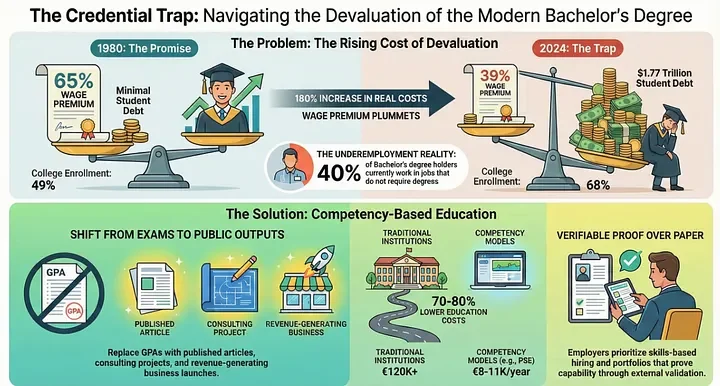
Chart illustrating the long-term erosion of the bachelor’s degree wage premium in the United States, highlighting credential inflation and declining returns to higher education over four decades.
The Higher Education Lab | Credential Collapse Series (5/5)
Skills-Based Hiring Expanded Talent Pools 6.1x: The Data Behind the Shift (4/5)
The Diploma ROI Crisis: When Does a €120K Credential Stop Being Worth It? (3/5)
Why Companies Like Google, IBM, and Apple No Longer Require College Degrees (2/5)
The bachelor’s degree once signaled scarce, job-ready talent. Today, rising enrollment, credential inflation, and stagnant wage premiums have weakened its economic value. This article examines how and why the degree’s labor-market signal eroded, and what employers now observe instead.
Executive Summary
- The bachelor’s degree wage premium fell from ~65% (1980) to ~39% (2024).
- Tuition costs increased by approximately 180% in real terms.
- Credential possession no longer reliably predicts earnings or job performance.
- Employers increasingly prioritize skills, portfolios, and verifiable outputs.
- Credential inflation is a structural economic problem, not an individual failure.
Degree Value Decline, Wage Premiums & Education Economics
The economics professor sits in my office with a graph she doesn’t want to show her students. It tracks the wage premium for bachelor’s degree holders relative to high school graduates, 1980–2024.
In 1980: 65% wage premium. A bachelor’s degree holder earned 65% more than someone with only high school completion.
In 2024: 39% wage premium. Same credential, 40% less economic advantage.
“I tell them education is a good investment,” she says. “But the data is getting harder to defend.”
Bachelor’s degree wage premium fell from +65% to +39%
Same credential, ~40% less economic advantage
The Credential Devaluation
Wage premium decline: ~40%
Degree cost increase: ~180%
Result: More expensive credentials with lower returns
The Federal Reserve Bank’s analysis of education returns found that between 1980–2024, the bachelor’s degree wage premium compressed by nearly 40% while the cost of obtaining that degree increased 180% in real terms (Federal Reserve, 2024).
This is classic inflation, except instead of currency devaluation, it’s credential devaluation. A bachelor’s degree purchased less economic advantage in 2024 than the same credential purchased in 1980, while costing dramatically more to obtain.
The Georgetown Center on Education and the Workforce tracked this phenomenon across multiple dimensions:
Wage premium erosion:
1980: BA holders earned 65% more than HS graduates
2000: 56% wage premium
2010: 48% wage premium
2024: 39% wage premium
Within-credential variance increased:
Top 25% of BA holders: +60–80% premium
Bottom 25%: Often earn less than median high-school graduates
Top 25% of BA holders: Still earn significant premiums (60–80% above HS)
Bottom 25% of BA holders: Earn less than median HS graduate in many fields
Credential possession no longer reliably predicts earnings
Field-dependent outcomes:
STEM degrees: Premium holding steady or growing
Business degrees: Premium declining, highly variable by institution
Liberal arts/humanities: Premium collapsed; many earn < HS median
The bachelor’s degree became simultaneously more expensive and less valuable, classic credential inflation.
Why This Happened
Credential inflation resulted from supply-demand dynamics in both education and labor markets.
Supply side (too many credentials):
College enrollment rate:
1980: 49% → 2020: ~68%
Result: Credential becomes baseline, not differentiation
College enrollment rates increased from 49% of high school graduates in 1980 to 68% in 2020 (NCES, 2023). What was once a distinguishing credential became baseline expectation. When everyone has a bachelor’s degree, no one has a competitive advantage from possessing it.
For-profit universities expanded aggressively, often optimizing for enrollment revenue rather than education quality. Millions of students earned degrees with minimal competency development.
Grade inflation meant GPA lost signaling value. The average GPA at four-year institutions increased from 2.9 (1990) to 3.4 (2022), making it harder for employers to distinguish high and low performers (Teachers College, Columbia, 2023).
Demand side (employers learned credentials don’t predict performance):
Degree possession ≠ job performance
Stronger predictors: skills, prior work, verified output
Companies discovered that degree possession didn’t correlate with job performance (as Google, IBM, and others documented through internal analysis).
Skills-based hiring emerged as alternative. Employers began valuing demonstrated capability over credential possession.
Automation and AI reduced demand for routine cognitive work — exactly the category where bachelor’s degrees used to guarantee employment.
The result: Too many credentials chasing too few positions that actually require them. Classic inflationary pressure.
The Individual Impact
For individual students, credential inflation creates a painful bind.
Not having a bachelor’s degree excludes you from many positions (even though the credential doesn’t predict performance). But having a bachelor’s degree no longer guarantees returns sufficient to justify the cost.
1980: +65%
2000: +56%
2010: +48%
2024: +39%
Georgetown’s data shows:
28% of workers with associate’s degrees out-earn median bachelor’s holders
40% of bachelor’s degree holders work in jobs that don’t require degrees
Student debt now exceeds $1.77 trillion (Federal Reserve)
You’re pressured to obtain an expensive credential that provides uncertain returns. Classic credential trap.
This matters most for students from families without wealth cushions. When a bachelor’s degree costs €100–120K total, you’re betting your economic future on a credential whose value is actively depreciating. If it doesn’t generate a sufficient wage premium, you’re worse off than if you’d started working at 18 and avoided the debt.
The Deflationary Alternative
The solution to credential inflation isn't "don't get educated." It's "don't confuse credentials with competencies."
What actually creates economic value:
Demonstrated capabilities employers can verify
Professional networks that create opportunities
Entrepreneurial execution ability
Continuous learning and skill updating
None of these requires a bachelor's degree. All of them can be built while earning an accredited degree — if the degree is structured around capability development rather than credential accumulation.
This is why the Paris School of Entrepreneurship redesigned degree programs around competency demonstration, not credential inflation.
PSE is an independent private higher education institution recognized by France's Ministry of Education, offering Bachelor (3–4 years), Master (2 years), and PhD (3 years) programs structured to produce both accredited degrees and verifiable portfolios.
The PSE approach:
Assessment isn't based on exams or GPAs—it's based on public outputs that external validators must accept. Students produce professional work throughout their degree: articles published in recognized media with editorial oversight, consulting projects with paying clients who provide structured feedback, and businesses that generate actual, documented revenue. These aren't hypothetical exercises graded by professors; they're real outputs that publishers, clients, and customers must validate.
Students can't inflate their way to graduation. The market decides whether their work is acceptable, not just internal academic standards.
Academic rigor comes from integrating content from institutions like Harvard, Michigan, and Imperial College, with assessment methods that test whether students can apply concepts to new challenges rather than recall them temporarily for exams.
The hybrid model allows students to study from anywhere while strategically accessing Paris's intellectual ecosystem—Station F for entrepreneurship, Paris School of Economics for research, OECD and UNESCO for policy work—without required relocation or expensive campus housing. Flexible scheduling enables students to work or operate businesses while completing their degree.
Graduate outcomes:
At graduation, students possess both credentials and competencies:
An accredited French degree (the credential employers recognize)
Published articles in recognized venues (writing and communication proof)
Client testimonials from consulting work (professional delivery validation)
Launched businesses with documented revenue (entrepreneurial execution evidence)
Certificates from prestigious universities (rigorous coursework confirmation)
Employers evaluating PSE graduates don't just see an inflated credential—they see verified competencies: published work they can read, businesses they can check, clients they can contact, and certificates they can validate.
This is what happens when you structure education around the competencies that actually create economic value rather than the credentials that signal access to four-year programs.
Program cost: Approximately one-third of comparable elite programs, with the hybrid model eliminating expensive campus overhead while maintaining access to world-class resources.
Admissions: Selection based on demonstrated ambition and entrepreneurial mindset, with rapid decisions and flexible start dates throughout the year.
Cost structure:
Traditional Bachelor’s: €120K–200K
PSE Bachelor’s: €24K–44K
Cost reduction: ~70–80%
€8–11K per year (€24–44K total Bachelor vs €120–200K traditional)
70–80% cost reduction while producing both credential and portfolio
Admissions:
48-hour decisions
Three start dates annually
Open enrollment based on potential, not credentials
This isn’t about rejecting credentials, it’s about insisting credentials represent real competencies. But unlike grade-inflated credentials from credential mills, it comes with external validation of actual capability.
This is not a pitch. It’s a description of how to provide credential value without credential inflation.
What Comes Next
Credential inflation will likely continue. As automation displaces routine cognitive work, more workers will pursue higher credentials seeking differentiation. But more credentials won’t solve the problem if they don’t represent genuine capability development.
The market is already correcting. Skills-based hiring, portfolio assessment, and competency-focused evaluation are all responses to credential inflation. Employers are learning to look past the credential to the evidence.
For students, the strategic response is clear: Build verifiable competencies while earning credentials. Don’t optimize for GPA inflation — optimize for portfolio strength.
For families, the financial response is equally clear: Don’t pay €120K+ for an inflated credential. Invest in education that produces both the degree and demonstrated capabilities.
The credential inflation problem is structural. But individual families can make better decisions by recognizing the pattern and choosing accordingly.
For students evaluating degree programs: PSE offers a comparison framework at parisschoolofentrepreneurship.com/framework
Applications: 48-hour decisions. Three start dates.
Fall (October): Deadline May 31 Summer (May): Deadline March 31 Winter (February): Deadline November 30
Apply at parisschoolofentrepreneurship.com/onlineapplication or contact@parisschoolofentrepreneurship.com
References & Sources
Credential Inflation Explained
Credential Inflation: Why Your Bachelor’s Degree Is Worth Less Than Your Parents’ Was — Medium
👉 https://parisschoolofentrepreneurship.medium.com/credential-inflation-why-your-bachelors-degree-is-worth-less-than-your-parents-was-78aec258712c
Federal Reserve – College Wage Premium Overview
What happened to the college wage premium? — Federal Reserve Bank of Minneapolis
👉 https://www.minneapolisfed.org/article/2025/what-happened-to-the-college-wage-premiumCredentialism & Degree Inflation (Background Theory)
Credentialism and degree inflation — Wikipedia overview
👉 https://en.wikipedia.org/wiki/Credentialism_and_degree_inflationGeorgetown CEW Earnings Data (Support Insight)
The Major Payoff: Evaluating Earnings and Employment Outcomes Across Bachelor’s Degrees — Georgetown CEW
👉 https://cew.georgetown.edu/cew-reports/major-payoff/OECD Labour-Market Relevance Report (Context on employment)
Labour Market Relevance and Outcomes of Higher Education — OECD
👉 https://www.oecd.org/content/dam/oecd/en/publications/reports/2020/07/labour-market-relevance-and-outcomes-of-higher-education-in-four-us-states_faea8537/38361454-en.pdfDegree Inflation to Social Outcomes (French Context)
Inflation des diplômes — Wikipedia (French)
👉 https://fr.wikipedia.org/wiki/Inflation_des_dipl%C3%B4mes
Frequently Asked Questions
Credential inflation occurs when academic degrees lose their signaling value because more people obtain them, leading employers to demand higher credentials without corresponding increases in skills or productivity.
Yes. The wage premium for bachelor’s degree holders relative to high-school graduates has steadily declined since 1980 due to oversupply of degrees, rising costs, and weaker labor-market signaling.
On average, degree holders still earn more than non-degree holders, but returns vary widely by field, institution quality, and total cost. High-cost, low-signal programs carry the greatest risk.
Administrative expansion, regulatory compliance, credential competition, and labor-intensive education delivery have pushed tuition costs upward faster than labor-market returns.
Students should prioritize programs that combine accredited degrees with verifiable skills, portfolios, work experience, and real-world outputs.