
What Employers Actually Want: McKinsey’s Data on Skills vs Credentials
What McKinsey’s data reveals about why skills now predict performance better than degrees
The Higher Education Lab | Credential Collapse Series: ‘The Employer Perspective — Why companies stopped requiring degrees’ (1/5)
As employers began measuring what actually predicts performance, a clear pattern emerged: academic credentials are weak signals of on-the-job success. Drawing on McKinsey’s research and large-scale employer hiring data, this article explains why skills, portfolios, and demonstrated execution now outperform degrees as indicators of professional capability
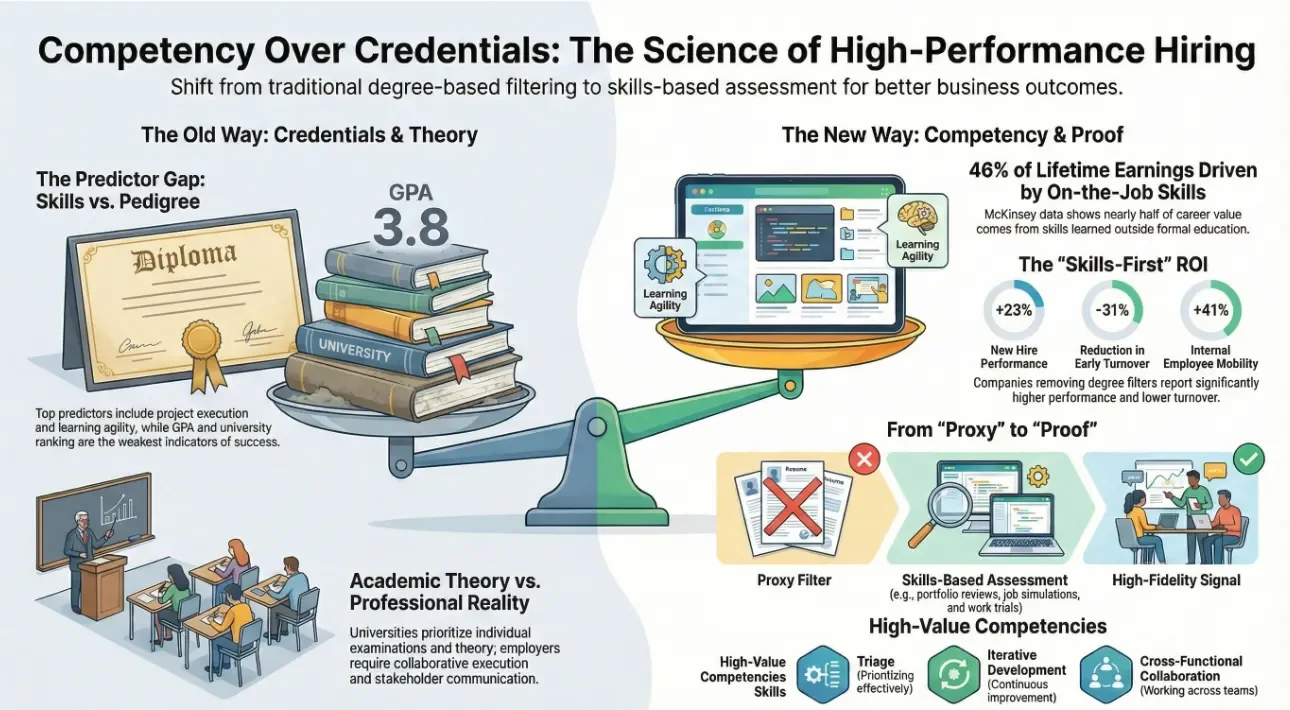
A visual summary of McKinsey’s employer research comparing academic credentials with demonstrated skills as predictors of on-the-job performance.
McKinsey Skills Research, Employer Hiring Criteria & Competency Assessment
The hiring manager slides the spreadsheet across the table. Two columns: “Credential Requirements” and “Actual Job Performance Correlation.” The numbers tell a story of her company spending eighteen months and a significant budget on discovering.
“We tracked 1,200 hires over three years,” she says. “GPA? Zero correlation with performance reviews. University prestige? Weak correlation that disappeared after year one. The only thing that predicted success was whether they’d done similar work before — even if they learned it outside formal education.”
Her company isn’t alone. This pattern appears across industries, geographies, and company sizes when organizations actually measure what matters.
The McKinsey Analysis
McKinsey & Company’s 2023 research on human capital development quantified what forward-thinking employers had been observing: the skills that drive career earnings are learned primarily outside formal credentialing systems.
Their finding: Skills learned on the job account for 46% of lifetime earnings. Formal education accounts for the remainder, but the value concentrates in specific competencies, analytical thinking, communication, and problem-solving, not in credential possession itself (McKinsey Global Institute, 2023).
This creates a fundamental misalignment. Universities optimize for credential conferral: coursework completion, examination performance, and GPA accumulation. Employers need a capability demonstration: Can you execute projects? Handle ambiguity? Iterate based on feedback? Communicate clearly?
The credential was supposed to signal these capabilities. What McKinsey’s data reveals is that the signal is weak at best, misleading at worst.
What Actually Predicts Performance
When organizations analyze their own hiring outcomes, as opposed to trusting credential proxies, consistent patterns emerge.
LinkedIn’s 2024 Global Talent Trends report synthesized hiring data from 15,000+ companies. The competencies that correlated with high performance ratings:
Top 5 Performance Predictors:
Demonstrated project execution (portfolio evidence, prior work samples)
Problem-solving in novel contexts (assessment performance, case studies)
Communication clarity (writing samples, presentation ability)
Learning agility (ability to acquire new skills rapidly)
Professional judgment (decision-making under uncertainty)
Bottom 5 Performance Predictors:
GPA
University ranking
Degree prestige
Academic honors/awards
Recommendation letters from professors
The data is unambiguous: What universities measure (grades, test scores, academic achievement) doesn’t predict what employers need (execution, adaptation, judgment).
Deloitte’s 2024 Human Capital Trends report found similar results across 10,000 organizations in 25 countries. When companies implemented skills-based assessment and stopped filtering by credentials, they reported:
23% improvement in new hire performance ratings (first-year reviews)
31% reduction in early turnover (departures within 18 months)
41% increase in internal mobility (employees moving to new roles successfully)
The improvements stem from hiring for actual capability rather than proxy credentials.
The Competency Gap
McKinsey’s research identified specific gaps between what credentials signal and what work requires.
University Curricula Emphasize:
Theoretical knowledge absorption
Individual examination performance
Disciplinary specialization
Abstract problem-solving
Academic writing conventions
Professional Work Requires:
Applied knowledge implementation
Collaborative project delivery
Cross-functional integration
Constrained problem-solving (time, budget, politics)
Stakeholder communication (technical → non-technical)
These aren’t completely different skillsets, but the overlap is smaller than universities and students assume. A student can master university requirements (high GPA, dean’s list, honors) while developing limited professional execution capability.
This explains why employers increasingly ignore GPAs. A 3.9 GPA signals exam performance. It doesn’t signal project management, client communication, iterative development, or professional judgment under ambiguity — the competencies McKinsey’s research shows matter most.
What Employers Are Measuring Instead
Organizations that moved beyond credential filtering implemented alternative assessment approaches.
Portfolio Review: Companies request evidence of actual work: code repositories, design portfolios, writing samples, and project documentation. This allows direct evaluation of quality and scope.
Example: Stripe (payments platform) reviews GitHub contributions and open-source project involvement for engineering candidates. Demonstrated code quality matters more than computer science degree possession.
Skills Assessments: Candidates complete job-simulated tasks under realistic constraints. Performance on actual work samples predicts job performance better than credential proxies.
Example: McKinsey itself uses case study performance, not an undergraduate institution, as a primary filter for consultant hiring. They discovered their own credentials didn’t predict consulting capability.
Structured Interviews: Behavioral interviewing focused on past performance in similar situations: “Tell me about a time you had to…” Questions assess judgment, problem-solving, and learning from experience.
Work Trials: Short-term projects or paid trial periods where candidates do actual work. This provides the highest-fidelity signal of future performance but requires more company investment.
Reference Checks on Deliverables: Instead of asking “Did they graduate?” companies ask “Can you describe their actual work output and professional capabilities?”
All these approaches share one characteristic: They assess demonstrated competency rather than credential possession.
The Skills Employers Can’t Get from Degrees
McKinsey’s analysis highlighted specific high-value competencies that formal education rarely develops:
1. Professional Execution Under Constraints Academic work has flexible deadlines, abundant resources, and few competing priorities. Professional work has hard deadlines, limited budgets, and constant priority conflicts. These constraints require different skills: triage, trade-off analysis, and stakeholder management.
2. Client Communication Universities teach peer communication (classmates) and upward communication (professors). Professional work requires communicating with clients who lack your expertise, don’t understand technical details, and care primarily about business outcomes.
3. Iterative Development Academic work emphasizes getting the right answer. Professional work emphasizes getting to workable solutions through iteration, testing, and refinement based on feedback. The mindset shift matters more than specific knowledge.
4. Cross-Functional Collaboration Universities are siloed by discipline. Professional work requires collaboration across functions: engineering + design + marketing + sales. This requires translation skills, perspective-taking, and integration thinking.
5. Entrepreneurial Judgment: Recognizing opportunities, assessing risk/reward, and making decisions without complete information. These capabilities develop through building things — businesses, projects, products — not through coursework.
The World Economic Forum’s Future of Jobs Report 2023 identified entrepreneurship and continuous learning as the two capabilities most critical for future career success. Both are learned primarily through doing, not through credentialing.
How One Institution Restructured Around This
This is why the Paris School of Entrepreneurship redesigned degree programs around the competencies McKinsey's research shows employers actually need.
PSE is an independent private higher education institution recognized by France's Ministry of Education, offering Bachelor (3–4 years), Master (2 years), and PhD (3 years) programs structured around demonstrated competency development rather than credential accumulation.
Assessment isn't based on exams testing knowledge retention. It's based on public outputs demonstrating professional execution.
Required Competency Demonstrations:
Students must produce verifiable professional work throughout their degree, validated by external stakeholders rather than just academic grading:
Published articles in recognized media with editorial oversight, developing clear writing, structured argumentation, and stakeholder communication. These aren't blog posts—they're publications that editors must accept, and readers engage with.
Consulting projects with paying clients who provide structured feedback, developing professional execution under constraints, client communication, deliverable quality, and deadline management. Real clients paying real fees for real outcomes.
Launched businesses generating documented revenue, developing entrepreneurial judgment, market validation, iterative development, and execution under uncertainty. Actual ventures with paying customers, not hypothetical business plans.
Academic Foundation:
Rigorous theoretical grounding comes from integrating content from institutions like Harvard, Michigan, and Imperial College. Students engage with university-level coursework and earn verifiable certificates, with assessment focused on whether they can apply concepts to new challenges rather than temporarily memorize material for exams.
The Hybrid Model:
Students can study from anywhere while strategically accessing Paris's unparalleled intellectual ecosystem. The city offers world-class resources for entrepreneurship, academic research, policy engagement, and intellectual culture through institutions like Station F, Paris School of Economics, OECD, UNESCO, Collège de France, Cité universitaire, Banque de France, and the International Chamber of Commerce—accessible through seminars, conferences, workshops, and public lectures without campus confinement or relocation requirements.
Graduate Outcomes:
Students exit with both an accredited degree and demonstrated competencies that employers can verify directly:
Published articles demonstrating communication ability
Client testimonials validating professional execution
Launched businesses proving entrepreneurial judgment
University certificates confirming rigorous coursework completion
When hiring managers evaluate PSE graduates, they're not trusting GPA or university ranking. They're reviewing actual work: published articles they can read, client projects they can verify, businesses they can assess, and certificates they can validate.
This is portfolio-based hiring, exactly what McKinsey's research shows predicts performance.
Investment: Approximately one-third the cost of traditional elite programs, with the hybrid model eliminating expensive campus housing while maintaining access to world-class intellectual resources.
Admissions: 48-hour decision timelines, three start dates per year (Fall/October with May 31 deadline, Summer/May with March 31 deadline, Winter/February with November 30 deadline), and open enrollment based on skills assessment rather than credential requirements.
The institution selects for demonstrated potential, ambition, diligence, and entrepreneurial mindset, not for credential possession or standardized test performance.
This is not a pitch. It’s a description of what education looks like when structured around the competencies McKinsey’s research shows employers actually value: demonstrated capability, not credential collection.
The Employer Perspective Going Forward
Organizations face a choice: Continue filtering by credentials despite evidence that they don’t predict performance, or restructure hiring around competency assessment.
McKinsey projects that by 2027, skills-based hiring will become standard practice at 60% of large organizations globally (up from 25% in 2024). The early movers gain a competitive advantage in talent acquisition. The laggards face constrained talent pools and higher hiring costs.
For students, this creates an asymmetric opportunity. Those who organize education around building demonstrable competencies, published work, completed projects, and launched ventures will enter a labor market increasingly structured to reward exactly that.
Those who optimize for GPA and credential prestige will find themselves competing with a credential that matters less every year, lacking the portfolio evidence employers increasingly require.
The question isn’t whether education matters; it does. The question is what kind of education produces the competencies McKinsey’s data shows employers actually need.
For students evaluating degree programs: PSE offers a framework comparing credential-based and competency-based education at parisschoolofentrepreneurship.com/framework
Applications: 48-hour decisions. Three start dates annually.
Fall semester (October start): Deadline May 31 Summer semester (May start): Deadline March 31 Winter semester (February start): Deadline November 30
Apply at parisschoolofentrepreneurship.com/onlineapplication or contact@parisschoolofentrepreneurship.com
FAQ
Many employers still value education, but evidence increasingly shows that degrees alone are weak predictors of on-the-job performance compared with demonstrated skills and work evidence.
Employers often get stronger predictive signals from portfolios and work samples, job-simulated skills assessments, structured interviews, and evidence of execution on real projects.
Skills-based hiring prioritizes demonstrated competencies—tested ability, past project outcomes, and practical execution—over proxies like degree prestige, GPA, or academic honors.
Portfolios let employers evaluate real outputs—how someone writes, builds, analyzes, and solves problems—rather than inferring capability from credentials.
Publish structured writing, complete real client projects, build products or ventures, document outcomes, and assemble verifiable artifacts that demonstrate execution and learning agility.