

The Hiring Manager's Dilemma: Why Degree Filters Screen Out the Talent You Need
Why degree filters quietly eliminate top performers and weaken hiring outcomes
The Higher Education Lab | Credential Collapse Series: The Hiring Manager's Dilemma: Why Degree Filters Screen Out the Talent You Need (2/5)
The Employer Perspective — Why companies stopped requiring degrees’ (1/5)
Degree requirements are meant to simplify hiring decisions, but growing evidence shows they do the opposite. By filtering on credentials rather than demonstrated capability, employers eliminate large portions of qualified talent while gaining no improvement in hire quality. This article examines the data behind the hiring manager's dilemma and why skills-based assessment produces better outcomes.
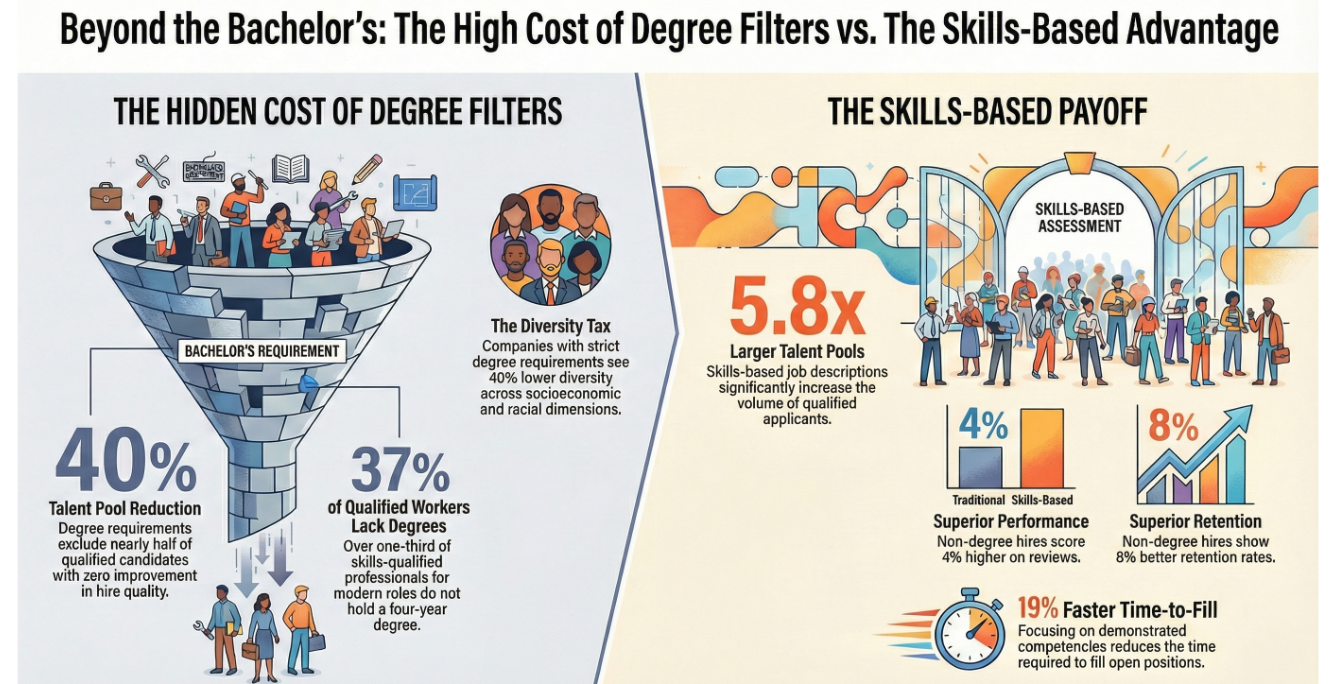
Infographic illustrating the contrast between traditional bachelor’s degree filters and skills-based hiring. The visual shows how degree requirements reduce talent pools by 40% and exclude 37% of qualified workers, while skills-based assessment increases applicant pools by 5.8x, improves performance by 4%, boosts retention by 8%, and shortens hiring time by 19%. The graphic highlights the diversity impact and the advantages of portfolio and competency-based evaluation in modern recruitment.
The hiring manager has 300 applications for three positions. Her first filter: "Bachelor's degree required." 180 applications remain. She just eliminated 120 candidates, including the person who would have been her top performer.
She doesn't know that yet. She won't find out until two years from now when a competitor hires one of those screened-out candidates, who then builds the product feature her team has been struggling to ship.
This is the hiring manager's dilemma: The filter designed to simplify decisions is systematically excluding exactly the talent you need.
The Credential Filter's Hidden Cost
TestGorilla's 2024 analysis of hiring outcomes across 1,500 companies quantified what many organizations discovered through painful experience: degree requirements reduce qualified candidate pools by an average of 40% while showing zero improvement in hire quality.
The math is straightforward. When you require a bachelor's degree for a position that doesn't legally mandate it, you immediately exclude:
Self-taught professionals with 5+ years of relevant experience
Bootcamp graduates with demonstrable project portfolios
Career changers from adjacent fields with transferable skills
Military veterans with applicable training and leadership experience
International candidates with equivalent but non-US credentials
People who built businesses instead of attending university
Workers who learned through apprenticeships or on-the-job training
Boston Consulting Group's analysis found that 37% of skills-qualified workers for professional roles lack traditional four-year degrees. By maintaining degree requirements, companies screen out more than one-third of their potential talent pool, including many of their highest-potential candidates.
Who Gets Filtered Out
The profiles most likely to be excluded by degree filters are precisely the profiles many organizations claim they're seeking:
Self-Directed Learners: People who identified capability gaps, found resources, and taught themselves professional skills. These candidates demonstrate intrinsic motivation, learning agility, and self-management—yet degree filters eliminate them before interviews.
Entrepreneurial Builders: Individuals who launched businesses, managed clients, handled operations, and learned through market feedback. These candidates have execution capability and customer orientation—yet they're screened out for lacking credentials.
Non-Traditional Career Progressors: People who entered work early, developed expertise through experience, and built careers through demonstrated performance. These candidates often have deeper practical knowledge than recent graduates—yet credential requirements exclude them.
Harvard Business Review's 2023 study of hiring patterns found that companies enforcing strict degree requirements had 40% lower diversity metrics across socioeconomic, racial, and geographic dimensions. The credential filter doesn't just reduce talent pools—it systematically biases selection toward candidates with access to four-year programs, regardless of capability.
The Performance Data
Organizations that tracked hiring outcomes before and after removing degree requirements discovered the filter wasn't protecting quality—it was limiting access to top talent.
Accenture eliminated degree requirements for 40% of its US positions in 2023. Their analysis after 18 months:
Quality of hire scores: No statistical difference between degree and non-degree hires
Performance reviews: Non-degree hires scored 4% higher on average (likely selection effect—they had to demonstrate capability, not just credential possession)
Retention rates: 8% better retention among non-degree hires
Promotion velocity: Equivalent rates
IBM tracked similar patterns across its "new collar" hiring initiative launched in 2020. By 2024, 25% of their US workforce entered through skills-based pathways. Performance data showed these employees matched or exceeded traditionally credentialed peers across all metrics while bringing different perspectives and problem-solving approaches.
The pattern is consistent: Degree filters don't improve hire quality. They reduce candidate pools and screen out diverse, high-performing talent.
What Hiring Managers Actually Need
When organizations define job requirements based on actual work needs rather than credential proxies, the specifications shift dramatically.
Traditional Job Description: "Required: Bachelor's degree in Business, Marketing, or related field. 3.0 GPA minimum. Strong communication skills."
Skills-Based Job Description: "Required: Demonstrated experience managing digital marketing campaigns with documented results. Portfolio showing campaign strategy, execution, and analytics. Writing samples demonstrating clear stakeholder communication. Proficiency in Google Analytics, marketing automation platforms."
The second description is more work to screen—you can't just scan for "BA required." But it produces measurably better hiring outcomes because it specifies what the job actually requires.
Society for Human Resource Management's 2024 analysis found that skills-based job descriptions increased qualified applicant pools by an average of 5.8x while reducing time-to-fill by 19%. More candidates applied, but they were better qualified, so the later interview stages progressed more efficiently.
The Assessment Challenge
The reason degree filters persist despite evidence they don't work: They're simple. Scanning for "BA required" takes seconds. Evaluating portfolios, work samples, and skill assessments requires time and expertise.
This is a real trade-off. Skills-based hiring frontloads effort—more work in initial screening—to gain better outcomes in hire quality and retention.
Organizations that made this work implemented structured approaches:
Portfolio Review Systems: Standardized rubrics for evaluating work samples—code quality, writing clarity, design sophistication, project scope. This allows consistent evaluation across candidates.
Skills Assessment Platforms: Job-simulated tasks that candidates complete before interviews. Platforms like HackerRank (technical), TestGorilla (professional skills), or company-specific simulations provide objective performance data.
Structured Interview Protocols: Behavioral questions focused on past performance in situations relevant to the role. Trained interviewers using consistent rubrics reduce subjective bias.
Work Sample Evaluation: Asking candidates to complete small-scope projects relevant to the actual job. This provides the highest-fidelity signal but requires company investment.
These approaches require more sophistication than degree filtering. But the ROI is clear: better hires, lower turnover, expanded talent pools, improved diversity.
How Education Should Respond
This creates an opportunity for higher education institutions. If employers are moving to portfolio-based assessment, degrees should be structured around portfolio development.
This is why the Paris School of Entrepreneurship redesigned degree programs around the competencies employers actually need.
PSE is an independent private higher education institution recognized by France's Ministry of Education, offering Bachelor (3–4 years), Master (2 years), and PhD (3 years) programs structured around demonstrated competency development rather than credential accumulation.
Assessment Model: Public Outputs, Not Private Exams
Assessment isn't based on exams testing knowledge retention. It's based on public outputs demonstrating professional execution.
Required Competency Demonstrations:
Students must produce verifiable professional work throughout their degree, validated by external stakeholders rather than just academic grading:
Published Articles: Students publish in recognized media with editorial oversight, developing clear writing, structured argumentation, and stakeholder communication. These aren't blog posts—they're publications that editors must accept, and readers engage with. Bachelor students publish 2–4 articles per year; Master students produce 8+ over their program.
Consulting Projects: Real consulting work with paying clients who provide structured feedback, developing professional execution under constraints, client communication, deliverable quality, and deadline management. Students complete 2–3 projects annually with actual clients paying real fees for real outcomes.
Launched Businesses: Students launch ventures generating documented revenue, developing entrepreneurial judgment, market validation, iterative development, and execution under uncertainty. Actual ventures with real market feedback, not classroom simulations.
Rigorous Coursework: EdX certificates from institutions like Harvard, the University of Michigan, and Imperial College London. Students complete the same rigorous content as on-campus students and earn verifiable certificates.
Jury Defenses: Semester-end sessions evaluating whether students can apply concepts to new scenarios, testing understanding rather than memorization.
Model Structure: Hybrid Design
Study from anywhere while engaging Paris's intellectual ecosystem strategically—OECD, Station F, Paris School of Economics, UNESCO—without campus confinement or required relocation.
Graduate Portfolio
When hiring managers evaluate PSE graduates using skills-based assessment, they find exactly what they're looking for:
Degree (Bachelor, Master, or PhD)
6–12 published articles (Bachelor) or 8+ (Master/PhD) hiring managers can read
Consulting client testimonials, hiring managers can contact
Launched businesses with documented revenue, and hiring managers can verify
EdX certificates from Harvard, Michigan, and Imperial, validating coursework
This is demonstrated competency with verifiable evidence—precisely what skills-based hiring requires.
Cost: €8–11K per year (€24–44K total Bachelor vs €120–200K traditional elite programs). The hybrid model eliminates expensive campus infrastructure.
Admissions: 48-hour decisions, three start dates per year (Fall/October, Summer/May, Winter/February with May 31, March 31, November 30 deadlines respectively). Open enrollment based on skills assessment, not credential filtering.
This isn't promotional content. It's a description of what education looks like when designed for the hiring model employers are already implementing: portfolio assessment, not credential filtering.
The Hiring Manager's Choice
Organizations face a decision: Continue using degree filters despite evidence that they reduce talent pools and don't improve quality, or invest in skills-based assessment infrastructure.
The early movers gain advantage—expanded talent pools, better diversity metrics, improved hire quality. The laggards face constrained hiring, missed talent, and competitive disadvantage.
For students, this shift creates opportunity. Those who build demonstrable portfolios—published work, completed projects, launched ventures—will enter a labor market increasingly structured to reward exactly that evidence.
Those who optimize only for credentials will find themselves with weak portfolios when employers request work samples, skill assessments, and competency demonstrations.
The credential filter is breaking down. Smart hiring managers are already removing it. Smart students should structure education accordingly.
For families evaluating degree programs: PSE offers a framework comparing credential-based and portfolio-based education at parisschoolofentrepreneurship.com/framework
Applications: 48-hour decisions. Fall deadline May 31, Summer deadline March 31, Winter deadline November 30.
Apply at parisschoolofentrepreneurship.com/onlineapplication or contact@parisschoolofentrepreneurship.com
Sources and References
TestGorilla (2024) - Skills-Based Hiring Report
40% candidate pool reduction with zero quality improvement
https://www.testgorilla.com/resources/skills-based-hiring-report/
Boston Consulting Group (2024) - Dismissed by Degrees
37% of skills-qualified workers lack four-year degrees
https://www.bcg.com/publications/
Harvard Business Review (2023) - The Emerging Degree Reset
40% lower diversity metrics with strict degree requirements
https://hbr.org/
SHRM (2024) - Skills-Based Hiring Revolution
5.8x applicant pool increase, 19% faster time-to-fill
https://www.shrm.org/topics-tools/research/
Accenture (2023-2024) - Skills-First Talent Strategy
18-month analysis: 4% higher performance, 8% better retention for non-degree hires
https://www.accenture.com/careers/
IBM (2020-2024) - New Collar Careers Initiative
25% of US workforce hired through skills-based pathways
https://www.ibm.com/employment/newcollar/
Burning Glass Institute + Harvard Business School - Labor Market Analytics
Real-time job posting analysis and degree requirement trends
https://www.burningglassinstitute.org/
LinkedIn Economic Graph - Hiring Trends Data
Skills-based hiring patterns across industries
https://economicgraph.linkedin.com/
World Economic Forum - Future of Jobs Report (Annual)
Skills transformation and global hiring practices
https://www.weforum.org/reports/
U.S. Bureau of Labor Statistics - Educational Attainment Data
https://www.bls.gov/emp/tables/educational-attainment.htm
French Ministry of Higher Education - Institutional Recognition
https://www.enseignementsup-recherche.gouv.fr/
OECD - Skills Strategy and Employment Analysis
https://www.oecd.org/employment/skills-and-work/
HackerRank - Developer Skills Report (Annual)
https://www.hackerrank.com/
edX - University Partnerships (Harvard, MIT, Michigan, Imperial)
https://www.edx.org/
Methodology: All quantitative claims reference published research reports, peer-reviewed studies, or publicly disclosed corporate analyses. Citations reflect most recent available data as of February 2026.