
The Diploma ROI Crisis: When Does a €120K Credential Stop Being Worth It?”
A data-driven analysis of when a €120K university degree still delivers positive ROI—and when alternative education models outperform traditional credentials.
University Costs, Student Debt & Education Investment Analysis
The Higher Education Lab | Credential Collapse Series (3/5)
Why Companies Like Google, IBM, and Apple No Longer Require College Degrees (2/5)
6 min read
A €120,000 university degree no longer guarantees a positive return on investment.
Since 2019, 87% of job categories have dropped formal degree requirements, while tuition costs have continued to rise faster than wages. At the same time, early-career salary premiums for many graduates have flattened or disappeared entirely.
This article examines when a traditional university degree still delivers strong financial returns, when it does not, and how alternative education models are reshaping the economics of higher education. Using labor-market data, cost analysis, and real-world outcomes, we analyze the diploma ROI crisis facing students and families in 2026.
What is the diploma ROI crisis?
The diploma ROI crisis refers to the growing gap between the rising cost of university education and the declining financial returns of many degrees, driven by credential inflation, skills-based hiring, and stagnant graduate wages.
Why the Traditional University ROI Model No Longer Works
For decades, the university ROI formula was straightforward: Invest €80–150K total in a bachelor’s degree, graduate into professional employment at €40–60K annually, earn the premium over high-school-only graduates, break even in 5–8 years, and accumulate wealth advantage over a career lifetime.
That calculation assumed:
A credential grants access to professional employment
Graduate salaries exceed non-graduate salaries reliably
Career advancement requires a degree
Debt is manageable relative to earning potential
All four assumptions have weakened substantially.
Georgetown University’s Center on Education and the Workforce found that 28% of workers with associate’s degrees now out-earn the median bachelor’s degree holder (2023). The credential premium compressed. Meanwhile, credential costs increased 180% in real terms since 2000 (OECD Education at a Glance 2024).
The formula broke because costs rose while labor market returns flattened. You’re paying more for credentials that guarantee less.
Learn more about alternative education models at PSE.
What €120K Actually Buys
The infographic below summarizes how rising degree costs have diverged from labor-market returns, highlighting the core dynamics of the diploma ROI crisis.
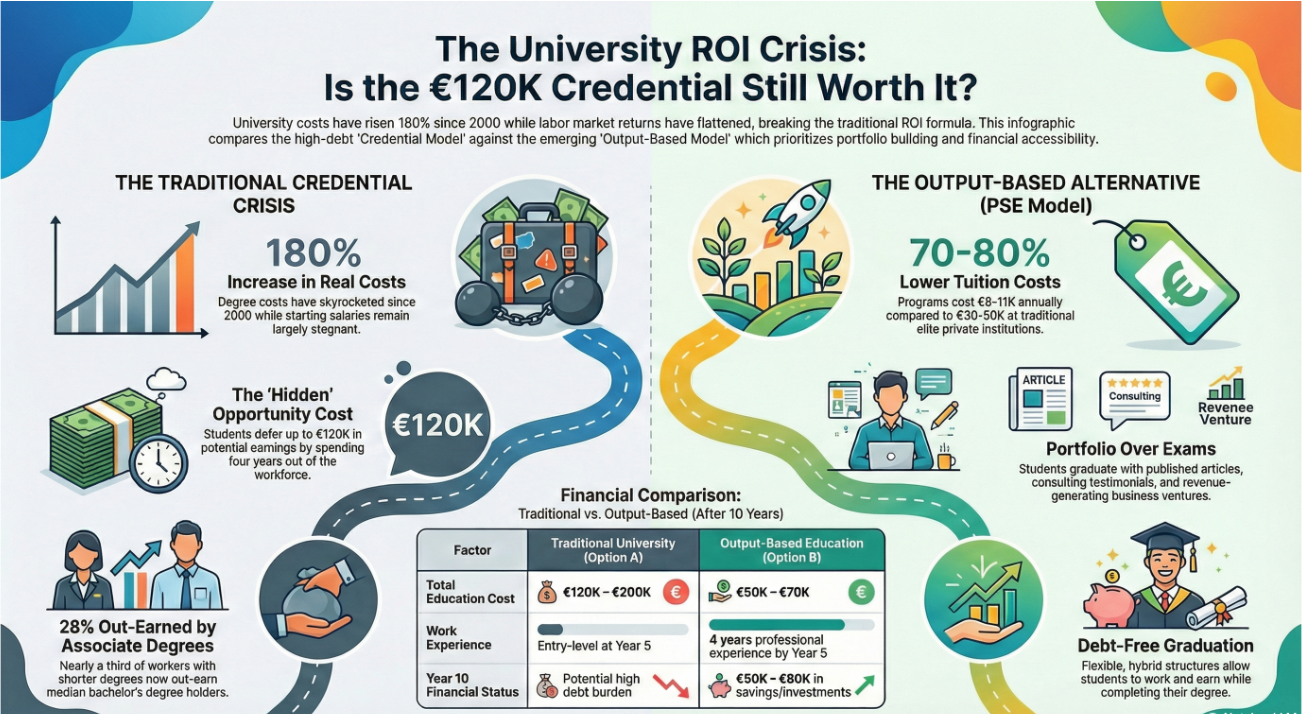
Cost versus return on investment of a €120K university degree compared with alternative education pathway
Key takeaways from the infographic:
– Total cost of a traditional degree: €120K–€200K
– Average graduate starting salary: €35K–€45K
– Alternative education models reduce costs by 70–80%
Let’s be specific about costs. A four-year program at a European university:
Annual Breakdown:
Tuition: €15–25K (private) or €5–12K (public elite)
Housing: €8–15K (varies by city)
Food: €3–5K
Books/materials: €500–1K
Transportation: €500–2K
Health insurance: €500–1.5K
Incidentals: €2–4K
Total annual: €30–50K
Four-year total: €120–200K
For US programs, add 30-50% to those figures according to College Board data.
What does that money purchase?
Access to:
Course lectures & certifications programs
Faculty office hours
Campus facilities (library, gym, social spaces)
Credential (bachelor’s degree)
Network (classmates, some alumni access)
What it doesn’t purchase:
Guaranteed employment
Professional competencies (often learned on the job)
Clear career trajectory
Protection from credential inflation
The credential still carries social weight. But the financial return on that €120–200K investment has become unpredictable.
The Debt Dimension
In the US, student loan debt reached $1.77 trillion in 2024 (Federal Reserve). Average borrower: $37,000 in debt at graduation. But averages obscure distribution… 20% of borrowers carry $50,000+, and graduate students often exceed $100,000.
Europe fares better due to public education systems, but private universities and international programs impose similar cost structures. And opportunity cost remains universal: four years not earning, not building businesses, not accumulating professional experience.
McKinsey’s research on career economics found that early-career earnings compound more than delayed high earnings (2022). Starting professional work at 18 versus 22 creates a four-year head start in salary growth, investment accumulation, and skill development. That opportunity cost rarely appears in ROI calculations but materially affects lifetime wealth.
When you invest €120K and four years in a credential, you’re not just paying tuition — you’re deferring €80–120K in potential earnings and delaying wealth accumulation by four critical years.
When Does the Math Work?
To be clear: Traditional university still makes economic sense for specific paths.
Positive ROI scenarios:
Medicine, law, and engineering (where credentials are regulatory requirements)
Research careers requiring a PhD progression
Elite institution access that creates genuine network advantages (top 10 universities globally)
Fields where institutional prestige matters for hiring (investment banking, management consulting at MBB firms)
Family wealth is sufficient that cost is irrelevant
Negative or uncertain ROI scenarios:
Generic business/liberal arts degrees from mid-tier institutions
Majors with weak labor market demand
High debt burden relative to expected starting salary
Fields where portfolio evidence matters more than credentials (creative work, technical roles, entrepreneurship)
The Georgetown study found the degree premium exists but varies wildly: Computer science graduates earn 78% more than high school graduates by age 30, while communications and humanities graduates earn only 15–20% more, often less than the cost of their education (2023).
The blanket assumption that “university = good financial investment” no longer holds. It depends entirely on major, institution, debt load, and alternative uses of that time and money.
Explore output-based education alternatives.
The Alternative Investment Framework
What if you invested €120K differently?
Option A: Traditional University
Years 1–4: €30K/year tuition + living = €120–200K total
Years 1–4: No professional income
Year 5: Enter job market at €35–45K (average)
Outcome at Year 10: Established career, possible debt, credential-based positioning
Option B: Output-Based Education + Early Career
Years 1–4: €8–11K/year education + living expenses reduced (no campus housing) = €50–70K total
Years 1–4: Part-time work or business revenue = €20–40K total earned
Year 5: Enter the market with a portfolio + degree + certificates at a comparable salary
Outcome at Year 10: Established career, no debt, €50–80K saved/invested, 4 years compound growth
The second option isn’t theoretical. It’s how the Paris School of Entrepreneurship structures degree programs.
PSE is an independent private higher education institution recognized by France’s Ministry of Education, offering Bachelor (3–4 years), Master (2 years), and PhD (3 years) programs designed around financial accessibility and output maximization.
Hybrid model: Students can study from anywhere and strategically immerse themselves in Paris's intellectual ecosystem — Station F for entrepreneurship, Paris School of Economics for research seminars, OECD and UNESCO for policy thinking, Collège de France for academic culture — without being confined to a single campus or forced to relocate to Paris.
Assessment is output-based:
Students publish articles in recognized venues (not blog posts, actual publications with editorial oversight)
Complete consulting projects
Launch businesses generating documented revenue
Not only exams. Real work with external validation.
Coursework integrates rigorous certificate programs from leading global institutions, including Harvard, Michigan, and Imperial College, in additional of some traditional lectures. Students engage with the same academic content available to on-campus students at these universities while demonstrating mastery through applied assessments that test conceptual understanding rather than memorization.
At Graduation:
French degree
published articles
Consulting client testimonials,
Launched businesses with documented revenue
Certificates from Harvard, Michigan, and Imperial validating coursework completion.
Total Cost:
€8–11K per year.
Four-year Bachelor total: €24–44K depending on completion pace.
That’s 70–80% less than traditional elite programs (€30–50K/year), and because the model is hybrid, students maintain a lower cost of living, no expensive Paris housing required unless they choose it.
Students can work part-time or run businesses while studying because the structure accommodates asynchronous learning and real-world project integration. Many PSE students generate revenue in consulting or business revenue during their degree, offsetting program costs partially or entirely.
Admissions reflects the cost-conscious philosophy:
48-hour decision timelines
Three start dates per year
Fall/October with a May 31 deadline
Summer/May with a March 31 deadline
Winter/February with a November 30 deadline
Open enrollment based on skills assessment rather than credential requirements. The institution selects for diligence, ambition, and entrepreneurial mindset, not family wealth or previous degree possession.
This is not a pitch. It’s a description of what becomes possible when you optimize education for ROI rather than credential prestige.
The ROI Question You Should Actually Ask
The question isn’t “Is university worth it?” in abstract.
The question is: “Given my specific goals, financial situation, and career path, does investing €120–200K and four years in this specific credential produce better outcomes than alternative uses of that time and money?”
For some students and some paths, the answer remains yes. In medicine, law, certain engineering specialties, and elite research careers, a credential is required or provides genuine advantages.
For many students pursuing generic degrees at mid-tier institutions, the answer is increasingly no. The debt burden, opportunity cost, and weakening labor market returns make it a poor financial investment.
The market has created alternatives. Output-based education, apprenticeship programs, skills certifications, entrepreneurship pathways, all structured around demonstrating capability rather than accumulating credentials.
The families who evaluate these options honestly, run the actual numbers, and choose based on ROI rather than social expectations will make better decisions.
The families who assume “university is always worth it” without calculating cost-benefit for their specific situation risk investing six figures in credentials that the market increasingly ignores.
That’s not ideology. It’s financial planning.
Take Action
For students and families evaluating education ROI:
📊 Calculate Your ROI - Compare traditional and output-based degree models
📝 Apply to PSE - 48-hour decisions, three start dates annually
📧 Questions? Email: contact@parisschoolofentrepreneurship.com
🌐 Learn More: parisschoolofentrepreneurship.com
Fall semester (October): Deadline May 31 Summer semester (May): Deadline March 31 Winter semester (February): Deadline November 30
Frequently Asked Questions (FAQ)
Is a university degree still worth the investment in 2026?
The ROI of a university degree depends on your specific field, institution, debt load, and career goals. Degrees in medicine, law, and engineering typically maintain strong ROI due to regulatory requirements. However, generic business or liberal arts degrees from mid-tier institutions increasingly show uncertain returns, with graduates earning only 15-20% more than high school graduates—often less than the cost of their education.
How much does a traditional 4-year bachelor's degree actually cost?
A traditional European bachelor's degree costs €120-200K total (€30-50K annually) including tuition, housing, food, materials, and living expenses. US programs cost 30-50% more. This doesn't include opportunity cost—the €80-120K you could have earned working during those four years.
What is output-based education?
Output-based education assesses students on real-world deliverables rather than exams: published articles, consulting projects with paying clients, launched businesses with documented revenue, and professional certificates. Students graduate with portfolios proving capability, not just credentials claiming knowledge.
How does PSE keep costs so low compared to traditional universities?
PSE's hybrid model eliminates expensive campus infrastructure costs. Students study from anywhere, access Paris's ecosystem strategically when needed, and aren't required to pay for campus housing. The focus on EdX certificate integration and output-based assessment reduces administrative overhead while maintaining academic rigor.
Can I work while studying at PSE?
Yes. PSE's asynchronous learning structure and project-based assessment allow students to work part-time or run businesses while studying. Many PSE students generate €10-25K in consulting or business revenue during their degree, offsetting program costs.
Is a PSE degree recognized internationally?
PSE is recognized by France's Ministry of Education as an independent private higher education institution. Graduates receive accredited French degrees. Additionally, students earn certificates from Harvard, Michigan, Imperial, and other EdX partner institutions, providing multiple forms of credential validation.
What's the typical starting salary for PSE graduates?
PSE graduates enter the job market with portfolios (published articles, consulting clients, launched businesses) plus degrees plus EdX certificates. Market positioning is comparable to traditional graduates (€35-45K starting), but without debt burden and with 4 years of wealth accumulation advantage.
How quickly can I get an admissions decision?
PSE provides admissions decisions within 48 hours of application submission. There are three start dates annually (Fall/October, Summer/May, Winter/February), allowing flexibility in when you begin your studies.
Do I need previous university credentials to apply to PSE?
No. PSE uses open enrollment based on skills assessment rather than credential requirements. Admissions evaluates diligence, ambition, and entrepreneurial mindset—not family wealth or previous degrees.
What's the difference between PSE's Bachelor, Master, and PhD programs?
All programs use output-based assessment with increasing complexity: Bachelor requires €500+ in business revenue, Master/PhD require €2,000+. Article publication expectations increase (2-4 annually for Bachelor, more for advanced degrees). Program lengths: Bachelor 3-4 years, Master 2 years, PhD 3 years. Learn more about programs →
Sources and References
Georgetown University Center on Education and the Workforce (2023). "The College Payoff: More Education Doesn't Always Mean More Earnings." cew.georgetown.edu
OECD (2024). "Education at a Glance 2024: OECD Indicators." Organisation for Economic Co-operation and Development. www.oecd.org/education/education-at-a-glance/
Federal Reserve (2024). "Consumer Credit - G.19." Federal Reserve Statistical Release. www.federalreserve.gov/releases/g19/current/
McKinsey & Company (2022). "The Future of Work After COVID-19." McKinsey Global Institute. www.mckinsey.com/featured-insights/future-of-work
College Board (2024). "Trends in College Pricing and Student Aid 2024." College Board Research. research.collegeboard.org/trends/college-pricing
Brookings Institution (2023). "Is College Worth It? A Comprehensive Return on Investment Analysis." www.brookings.edu/articles/is-college-worth-it-a-comprehensive-return-on-investment-analysis/
Times Higher Education (2025). "World University Rankings 2025." www.timeshighereducation.com/world-university-rankings