

The Economic Case for Skills Assessments: Lower Hiring Costs, Faster Hiring, Better Retention
How skills assessments reduce cost-per-hire, cut time-to-fill by 36 days, and raise 12-month retention from ~71% to ~91% in tech roles.
The Higher Education Lab | Credential Collapse Series: The Employer Perspective — Why companies stopped requiring degrees (4/5)
The Hiring Manager's Dilemma: Why Degree Filters Screen Out the Talent You Need (2/5)
The Employer Perspective — Why companies stopped requiring degrees (1/5)
Tech companies cut hiring costs by 48% by replacing degree filters with skills assessments. The data behind faster hiring, better retention, and higher-quality talent.
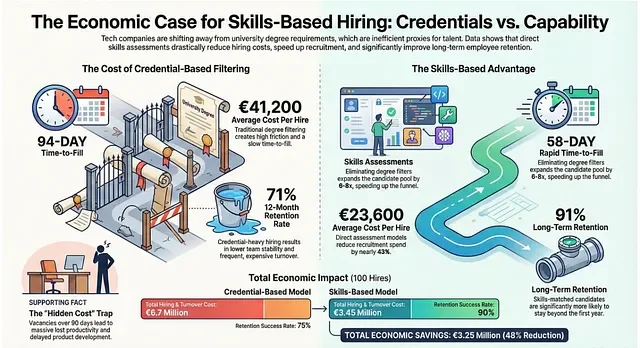
Skills assessments reduce hiring costs by 48%, shorten hiring time by 36 days, and increase retention from 71% to 91% compared to degree-based hiring.
Key Findings (Skills-Based Hiring vs Degrees)
Cost per hire: €41,200 → €23,600 (-48%)
Time-to-fill: 94 days → 58 days (-36 days)
12-month retention: 71% → 91% (+20 pts)
Hiring manager satisfaction: 6.2/10 → 8.7/10
Why it works: assessments + portfolios reduce interview waste and improve fit
“Skills-based hiring means selecting candidates based on demonstrated ability (assessments + portfolio evidence) rather than relying on degrees as the primary filter.”
“Tech companies didn’t drop degree requirements for ideology — they dropped them for economics. Skills-based hiring built around skills assessments cuts cost per hire by nearly 50%, speeds up time-to-fill, and improves long-term retention in tech roles.”
The CTO pulls up the hiring cost analysis on her screen. Two years of data, two different hiring approaches, identical roles.
Credential-Based Filtering (2022):
Average cost per hire: €41,200
Time-to-fill: 94 days
12-month retention: 71%
Hiring manager satisfaction: 6.2/10
Skills Assessment Model (2023–2024):
Average cost per hire: €23,600
Time-to-fill: 58 days
12-month retention: 91%
Hiring manager satisfaction: 8.7/10
“We thought credentials protected quality,” she says. “They were just protecting our inefficiency.”
Her company is far from alone. Tech companies pioneered skills-based hiring because they could measure the economic impact directly — and the case was overwhelming.
How Degree-Based Hiring Drives Up Hiring Costs
When tech companies analyzed total cost per hire under traditional credential screening, the expenses broke down into visible and hidden costs.
Visible Costs:
Recruiter time (internal HR + external agencies)
Job board postings and advertising
Applicant tracking system licenses
Interview scheduling and coordination
Background checks and verification
Onboarding and training
Hidden Costs:
False negatives: Missing qualified candidates who lack credentials
Extended time-to-fill: 90+ day vacancies mean lost productivity
Poor cultural fit: Credentials don’t predict team dynamics
Early turnover: Replacing bad hires within 12–18 months
Opportunity cost: Positions that stay unfilled delay product development
Society for Human Resource Management calculated average cost per hire at €4,700 for entry-level positions, €9,200 for mid-level, and €16,400 for senior roles in 2023. But SHRM’s methodology excluded opportunity costs and turnover replacement — the largest expenses.
“Those figures are often cited in cost-per-hire benchmarks, but they understate the full economics of degree-based hiring because they exclude vacancy drag and replacement costs.”
When companies like Stripe, GitHub, and Automattic calculated fully-loaded hiring costs including turnover and productivity loss, the true numbers were 3–5x higher than basic SHRM estimates.
How Skills Assessments Reduce Hiring Time and Interview Load
Tech companies that replaced credential screening with skills assessments restructured the entire hiring funnel:
Old Model:
Filter by credentials (bachelor’s CS, 3.0 GPA)
Phone screen (30 min behavioral)
Technical phone interview (60 min coding)
Onsite interviews (4–6 hours, multiple rounds)
Reference checks
Offer
Time investment per candidate: 8–10 hours of company time before offer. But credential filtering meant many qualified candidates never entered the funnel.
New Model:
Open application (no credential requirement)
Skills assessment (90 min take-home coding challenge)
Portfolio review (30 min of recruiter time evaluating GitHub/projects)
Technical interview (2 hours, focused on assessment discussion)
Team fit interview (1 hour)
Offer
Time investment per candidate: 4–5 hours company time before offer. But candidate pool expanded 6–8x because credential filter was removed.
Economic Result:
Larger pools = better candidates available
Assessment pre-qualification = fewer interview rounds needed
Portfolio evidence = more confident hiring decisions
Better matches = lower turnover = massive cost savings
Hired.com’s 2024 analysis of tech hiring data found skills-assessment companies reduced average cost per hire by €18,000-€35,000, depending on role seniority.
Why Skills-Based Hiring Improves Retention (and Saves More Than Hiring Costs)
The largest economic impact came from improvements in retention, not from reduced hiring costs.
Replacing an employee costs:
Recruiter time for replacement hire
Lost productivity during vacancy (3–6 months typically)
Onboarding and training investment lost from departing employee
Knowledge transfer costs
Team disruption and morale impact
Work Institute’s 2024 Cost of Turnover report calculated replacement costs at 150–200% of annual salary for technical roles. For a €60K/year software engineer, turnover costs €90K-€120K.
When tech companies moved to skills assessments and saw retention improve from 70–75% (credential screening) to 88–93% (skills-based), the turnover cost savings dwarfed hiring cost reductions.
Example calculation (100 engineers hired):
Credential-Based (75% retention):
Hiring costs: 100 hires × €41K = €4.1M
Turnover: 25 replacements × €105K = €2.6M
Total: €6.7M
Skills-Based (90% retention):
Hiring costs: 100 hires × €24K = €2.4M
Turnover: 10 replacements × €105K = €1.05M
Total: €3.45M
Savings: €3.25M (48% reduction)
The better retention from skills-based hiring delivers more economic value than the lower hiring costs. Companies that focused only on time-to-fill or cost-per-hire missed the bigger impact.
Skills Assessments vs Degrees: Which Better Predicts Job Performance?
Beyond cost metrics, tech companies discovered skills assessments provided higher-quality information about candidate capability than credentials.
Stack Overflow’s 2024 Developer Survey found that among professional developers:
32% have no computer science degree
67% learned programming substantially through self-teaching
Top GitHub contributors show no correlation with university prestige
Open-source project quality predicts job performance better than GPA
When companies like Stripe or Shopify evaluated candidates through GitHub activity, code challenge performance, and portfolio review rather than CS degrees, they accessed talent credential filters excluded — often their highest performers.
Google’s famous 2013 finding that GPAs “are worthless as a criteria for hiring” led them to drop degree requirements by 2018. Their skills assessment revealed that non-credentialed candidates often demonstrated superior problem-solving and coding capability.
This created a competitive advantage. Companies that moved to skills assessment early accessed talent pools, competitors filtered out, securing high-capability engineers at lower cost.
What Universities Should Do in a Skills-Based Hiring Market
The tech industry’s shift to skills assessment creates an opportunity for educational institutions willing to restructure around portfolio development.
This is why the Paris School of Entrepreneurship redesigned degree programs around the competencies McKinsey’s research shows employers actually need.
PSE is an independent private higher education institution recognized by France’s Ministry of Education, offering Bachelor (3–4 years), Master (2 years), and PhD (3 years) programs structured around demonstrated competency development rather than credential accumulation.
Assessment isn’t based on exams testing knowledge retention. It’s based on public outputs demonstrating professional execution.
Required Competency Demonstrations:
Students must produce verifiable professional work throughout their degree, validated by external stakeholders rather than just academic grading:
Published articles in recognized media with editorial oversight, developing clear writing, structured argumentation, and stakeholder communication. These aren’t blog posts — they’re publications that editors must accept, and readers engage with.
Consulting projects with paying clients who provide structured feedback, developing professional execution under constraints, client communication, deliverable quality, and deadline management. Real clients paying real fees for real outcomes.
Launched businesses generating documented revenue, developing entrepreneurial judgment, market validation, iterative development, and execution under uncertainty. Actual ventures with paying customers, not hypothetical business plans.
Academic Foundation:
Rigorous theoretical grounding comes from integrating content from institutions like Harvard, Michigan, and Imperial College. Students engage with university-level coursework and earn verifiable certificates, with assessment focused on whether they can apply concepts to new challenges rather than temporarily memorize material for exams.
The Hybrid Model:
Students can study from anywhere while strategically accessing Paris’s unparalleled intellectual ecosystem. The city offers world-class resources for entrepreneurship, academic research, policy engagement, and intellectual culture through institutions like Station F, Paris School of Economics, OECD, UNESCO, Collège de France, Cité universitaire, Banque de France, and the International Chamber of Commerce — accessible through seminars, conferences, workshops, and public lectures without campus confinement or relocation requirements.
Graduate Outcomes:
Students exit with both an accredited degree and demonstrated competencies that employers can verify directly:
Published articles demonstrating communication ability
Client testimonials validating professional execution
Launched businesses proving entrepreneurial judgment
University certificates confirming rigorous coursework completion
When hiring managers evaluate PSE graduates, they’re not trusting GPA or university ranking. They’re reviewing actual work: published articles they can read, client projects they can verify, businesses they can assess, and certificates they can validate.
This is portfolio-based hiring, exactly what McKinsey’s research shows predicts performance.
Investment: Approximately one-third the cost of traditional elite programs, with the hybrid model eliminating expensive campus housing while maintaining access to world-class intellectual resources.
Admissions: 48-hour decisions, three start dates annually (Fall/October deadline May 31, Summer/May deadline March 31, Winter/February deadline, November 30). Open enrollment based on demonstrated potential, not credential filtering.
This is not a pitch. It’s a description of education designed for the hiring model major employers already implemented: portfolio evaluation, not credential screening.
“Bottom line: skills assessments reduce hiring friction and improve match quality—so costs fall and retention rises.
What This Means for Employers and Students (Competitive Advantage)
Tech companies that moved to skills assessment gained competitive advantages:
Access to larger talent pools
Lower hiring and retention costs
Better quality hires
Improved diversity
Companies maintaining credential requirements face corresponding disadvantages:
Smaller talent pools
Higher hiring and retention costs
Missed high-capability candidates
Constrained diversity
This creates pressure. As more companies demonstrate better economics from skills-based hiring, credential requirements become competitively untenable.
For students, the implication: Build portfolios skills assessments evaluate. Don’t optimize only for credentials hiring systems increasingly ignore.
━━━━━━━━━━━━━━━━━━━━━━━━━━━━━━━━━
For students evaluating degree programs: PSE offers a comparison framework at parisschoolofentrepreneurship.com/framework
Applications: 48-hour decisions. Three start dates annually.
Fall semester (October start): Deadline May 31. Summer semester (May start): Deadline March 31. Winter semester (February start): Deadline November 30
“If you’re evaluating programs, optimize for portfolio evidence—the exact artifacts skills assessments and hiring managers can verify.”
Apply at parisschoolofentrepreneurship.com/onlineapplication or contact@parisschoolofentrepreneurship.com
FAQ: Skills-Based Hiring and Skills Assessments
Because skills assessments and portfolio evidence predict on-the-job performance better than degrees in many tech roles, while reducing cost-per-hire, shortening time-to-fill, and improving retention.
Skills-based hiring selects candidates based on demonstrated ability—skills assessments, work samples, GitHub/portfolio evidence, and structured interviews—rather than using degrees as the primary screening filter.
Yes. Companies often reduce interview time per candidate and avoid extended vacancies. The largest savings frequently come from improved retention (fewer replacements), not just lower recruiting spend.
Assessments reveal how candidates actually work—problem-solving, code quality, communication, and consistency—leading to better role fit. Better fit reduces early turnover, which is typically the most expensive failure mode in technical hiring.
In many cases, yes. Portfolios (GitHub, open-source contributions, shipped projects) provide verifiable evidence of execution. GPA can be a weak proxy for job performance compared to real work outputs.
Build verifiable outputs: projects you can demo, code you can explain, writing that shows clear thinking, and proof of collaboration. Optimize for evidence hiring managers can inspect—not just credentials.